
Category

Finance & Accounting

Finance & Accounting Services
Fractional Finance & Accounting Roles
Financial Consulting & Advisory Services

September 2023: Refreshing Your Performance Reviews

By Business Consulting, Finance & Accounting


Refreshing Your Performance Reviews– nurture retention & engagement

Written by Tom Prest

Many organizations have significantly transformed performance reviews over the past three years. This change was driven by the recognition that traditional processes were flawed, a realization emphasized by the pandemic when many employees started working virtually. Additionally, our workforce is changing and becoming increasingly complex. These factors have prompted numerous organizations to discard performance reviews or introduce modified versions to proactively create a more relevant process to respond to this evolving dynamic.

Read More

August 2023: When a fractional CFO is right for your business

By Business Consulting, Finance & Accounting


Stephanie Ford is a director of Warren Whitney and is responsible for Business Development. Stephanie has more than 20 years of diverse client experience, including manufacturers, financial services, distributors, professional services, real estate, and nonprofits.

When a fractional CFO is right for your business–why consider fractional c-suite expertise

Written by Stephanie Ford

For those not familiar with the concept of fractional leadership, it is an efficient and cost-effective model for businesses to outsource functions when they do not have the expertise in-house or are going through a transition. A fractional CFO is a part-time financial executive who works with your organization on an as-needed basis. They offer an objective perspective and can guide businesses when faced with challenging decisions. Their role is to be your trusted advisor, lead through change, and provide unbiased advice.

Read More

July 2023: Transitioning with QuickBooks- from Desktop to Online

By Business Consulting, Finance & Accounting


Transitioning with QuickBooks– from Desktop to Online -tips to ensure a smooth & successful transition

Written collaboratively by our Finance/Accounting Team

In today’s digital age, businesses are transitioning to cloud-based solutions to streamline their operations. Moving from desktop platforms to cloud-based ones may improve accessibility, cost efficiency, scalability, collaboration, and reliability. One widely used platform that is steering users to their online software is QuickBooks. QuickBooks is doing this by gradually limiting services to their desktop platform, making it clear that, inevitably, everyone needs to transition to their online cloud version. However, it is crucial to acknowledge that while QuickBooks Online (QBO) offers numerous benefits, there are drawbacks to QBO to consider, which include: the absence of certain reporting functions and other features in QuickBooks Desktop (QBD), a learning curve during the transition process, and limited control over updated schedules. For many organizations, relying on third-party integrated software will force or forestall a transition. This article explores the advantages of migrating from QBD to QBO, along with practical tips to ensure a smooth and successful transition.

Read More

June 2023: Maximizing the Value of Your Businesses Sale Transaction

By Business Consulting, Finance & Accounting


Maximizing the Value of Your Businesses Sale Transaction –tips to help plan & prepare to get the best value

By: Neil Suffa

For many entrepreneurs, owning and growing a business is your dream. You put your heart and soul into the business and watch it slowly grow while you and your investors prosper.   Then comes the hard part- – what do you want to do with it? Has the business succeeded so well that others want to purchase it and add it to their existing portfolio? Or is the sale of your business your retirement plan? Or do you simply want to grow the business? No matter what the reason is for your transition, the better prepared you are, the more value you will get for your business.

Immediately before joining Warren Whitney, I spent half a dozen years as a Controller/CFO of a private equity-owned manufacturing business. During that time, we went through the sale of our business twice and purchased another business with a third private equity sponsor. As a former CFO, Controller, and auditor, I also realized that planning and preparing for the sale of a business made the process easier and ultimately yielded the highest sale price for the business. Are you unsure what to do to plan for the next steps for your business? Here is an approach to help streamline the process to help you maximize the value of your business.

Read More

February 2023: Cashflow Forecasting- A vital tool for your business

By Business Consulting, Finance & Accounting


Helen Dow-Finance and Accounting Director

Cashflow Forecasting: A vital tool for your business to maximize performance & manage risk

By: Helen Dow

Cash is the fuel of business. Run out of it, and your business engine shuts down, leaving you with a machine that doesn’t work.

For something so crucial to the life and success of a business, you would think it would be given more prominence in strategic planning and day-to-day decision-making, especially since important decisions with long-term financial impact are often made. And some of those decisions involve future investments, balloon payments, and contingencies. The best tool to predict and manage cash levels is a Cashflow Forecast.

Read More

August 2022: Inflation- Business Leaders Under Pressure

By Finance & Accounting


Helen Dow-Finance and Accounting Director

Inflation:  Business Leaders Under Pressure: Managing your organization during inflationary times

By: Helen Dow

These last few years have challenged business leaders to navigate through a pandemic, supply disruptions, social unrest, and labor shortages. Likely, there were additional difficulties that were unique to your business or industry. My colleagues and I would often joke that we were rapidly filling in our disaster bingo card. Now we add to that list our first major inflationary environment in over 40 years.

This article looks at our current challenge of inflation as it affects companies in the United States. Its purpose is to help you as business owners and leaders recognize the stages of inflation and to consider the ways it might impact your operations. Most of us have been through a recession, yet few currently in leadership were managing an organization through any significant inflationary environment. Inflationary periods also trigger recessions and require the ability to respond to both economic impacts.  Financial history books will give ideas of what to expect, but the reality is this time is unique, and it may play out differently.

Read More

August 2022: Additional Information on Inflation

By Finance & Accounting


Finance & Accounting Director

Additional information on Inflation

By: Helen Dow

The Money Supply

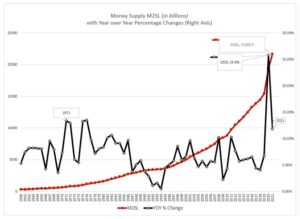
The supply of money should not outpace what the country needs to handle its growth. The Federal Reserve monitors and regulates this supply of money in circulation and they track and report on it with what they refer to as M2SL. Generally, M2SL is the amount of money in the banks that is a cash or cash equivalent (checking, savings, money market).

The supply of money is not the only driver of inflation but is often the most dangerous. Throughout history, when a government causes the increase to the supply of money (printing), that is not aligned with a country’s production (Gross Domestic Product or GDP) or an underlying value (e.g., gold, oil), there is a reset of its value. In other words, inflation on the cost of goods and services is really a deflation of the value of the currency. Everything being equal, the asset doesn’t change value, it is the dollar that decreases in value. Without correction or a stable valuation of that currency, confidence can erode which will compound the problem.

Below is a chart showing the supply of money in circulation, marked by the federal reserve’s measure of M2SL growth since the 1960s. The red line is the charted M2SL levels in billions (for clarity, the last data point is $21.6 trillion). The black line is a year-over-year percentage growth of M2SL. In other words, the black line is the yearly percentage increase in money supply in our economy. From 2020 to 2021, there was a 25% increase in the money supply. This is unprecedented in the years this has been measured.
Source of M2SL and data:  https://fred.stlouisfed.org/series/M2SL

US Debt

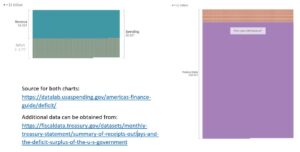
The Federal Reserve provides the money, but they do not cause the need for the increase. Government deficit spending has been the biggest driver recently. The pandemic brought on unprecedented disruptions. Our government increased spending to businesses and individuals through several very expensive supports. Our production plummeted, but our access to financial resources was never greater. Fortunately, government spending has slowed but it needs further curtailment. The US deficit spending for 2020 was $3.1 trillion.

The charts below give a visual of the US deficit spending for 2021 at $2.8 trillion and the total debt level at the year ended 2021.   Deficit spending is financed through government loans. Our national debt at the end of 2021 was $28.4 trillion and shows the 2021 deficit in red. We know this debt is now above $30 trillion.

2021 US Deficit Spending                                            2021 US Debt with 2021 Deficit Added
Inflation Measurements

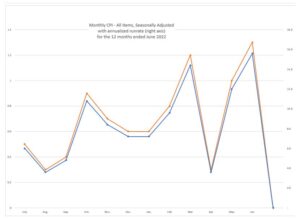
The Bureau of Labor Statistics releases the Consumer Price Index (CPI) which is our best measure of the impact from inflation. Below is a chart that shows the CPI – All Items, monthly increases. The left axis gives the seasonally adjusted rates as released by the Bureau. The right axis is annualized by simply multiplying by twelve, which you can do because it is seasonally adjusted. This is only to translate to a more meaningful number and comparable to historical annual amounts. The Bureau of Labor Statistics that releases this information gives an annual number that is for the previous twelve months. This produces a lag and understates the current levels in an increasing-rate environment. For July of 2022, the previous twelve months totaled 8.5%, but you can see in the chart that the trend is of an increasing rate. Energy has been the largest driver of fluctuations and the down spikes are from releasing reserves and lower futures based on the impact from an impending recession. The Food index has less volatility but a similar increasing trend.
Source of data:  Consumer Price Index Summary – 2022 M06 Results (bls.gov)

As stated, the money supply increased largely due to an expansion of government spending, increased our national debt levels, and provided the catalyst for entering an inflationary period. Now that we are here, the response of the Federal Reserve and the US government are critical to cool down a very heated set of inputs to inflation. Ignoring would be disastrous and hopefully there will be a commitment to getting this under control. The unfortunate part is it will not be without economic pain, and that will test their resolve.

Interest Rates

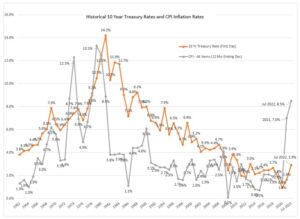
Another chart to show a historical view of the alignment between inflation and interest rates is a graph of CPI rates since the 1960’s, represented by the grey line, layered with the federal 10-year treasury interest rates, represented by the orange line. Note that the 2022 data point is the 12 months ended July 2022 and not a calendar 2022 value. On the current trajectory, we would expect the 2022 CPI to finish higher.
Sources of data:

CPI 12-month percentage change, Consumer Price Index, selected categories (bls.gov)

10-Year Treasury 10 Year Treasury Rate – 54 Year Historical Chart | MacroTrends

Historically, you can see the correlation between inflation and interest rates. And looking at the chart, the expectation would be that the interest rates will go up and substantially. Here is where history may not be a predictor. I’m not convinced it will follow exactly like the 1970s. Our large national debt is a major difference between now and then. In the 70’s, our national debt was less than 40% of GDP. It is now above 130% of GDP and high interest rates could be disastrous to a country that has its financing structured on low interest rates.


July 2022: Employee Retention Credit: It’s not too late

By Finance & Accounting


Finance & Accounting Director

Employee Retention Credit, It’s not too late: learn how to claim ERC credits retroactively

By: Gene Fitz

As a result of the COVID-19 pandemic, the federal government implemented several relief programs for organizations to help them survive the pandemic. One of these programs is the Employee Retention Credit (ERC), originally via the CARES Act. ERC is of particular interest because, unlike other programs under the CARES Act, the ERC can be claimed for three years after the filing date of the original payroll returns. This means companies can retroactively claim these credits after the initial period has passed. This article provides an overview of:

  • What is the ERC
  • Who is eligible
  • What information is needed to determine qualification
  • How to submit a claim retroactively Read More

Client List: Fractional Finance/Accounting Roles

By Business Consulting, Client, Finance & Accounting

Fractional CFO/Controller

Nonprofit Clients

Goodwill of Central Virginia

Trinity Episcopal School

Visual Arts Center of Richmond


For-Profit Clients

Activation Capital

Boldtrunners and Cannadips

Virginia Beer Wholesalers

Virginia Estate and Trust Law


Fractional Bookkeeping/Senior Accounting

Nonprofit Clients

Disability Law Center

Historic Richmond Foundation

James River Association

NextUp RVA

Second Presbyterian Church

The Community Foundation

Visual Arts Center of Richmond


For-Profit Clients

Boldtrunners and Cannadips

Hilb Group

Virginia Beer Wholesalers


MAKING POTENTIAL HAPPEN


December 2021: Advice to Achieve Success & Happiness

By Business Consulting, Finance & Accounting

Advice to Achieve Success and Happiness: Reflecting on a 40-year career

By: Gene Gregory

Having worked more years than I like to admit, there are a few things that I have learned that helped me succeed and find fulfillment in my work.  While we all approach our work careers differently, I hope my experiences will resonate with you. Here are three things I attribute to my continued success and passion:

  1. Define and evaluate career goals.
  2. Strive to make the most of the workday.
  3. Never stop learning.

Read More