


Looking Forward: A Practical Guide for Nonprofit Leaders
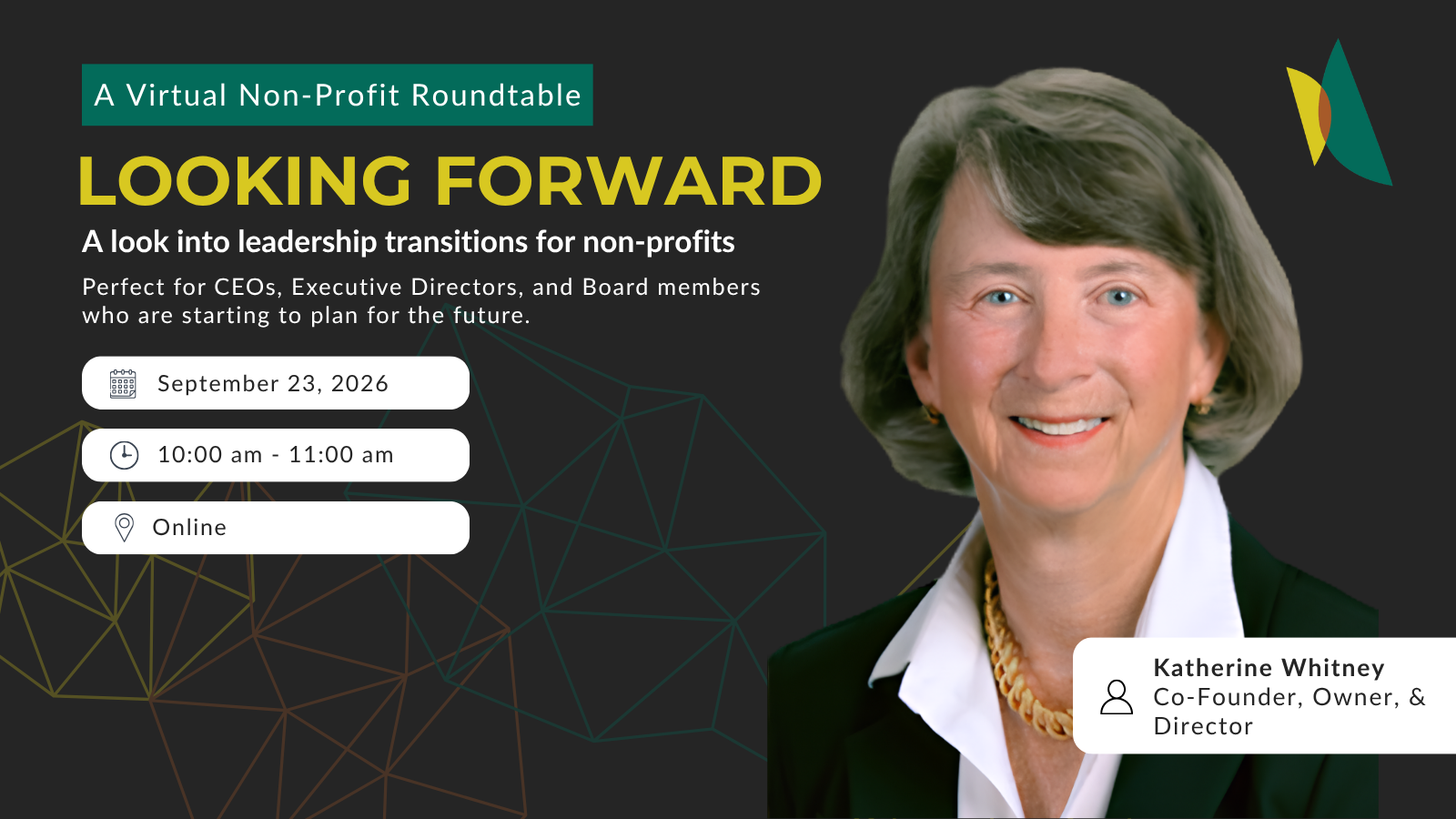
Led By: Katherine M. Whitney | Director & Founder | Warren Whitney
Leadership transitions do not always come with a long runway.
An executive director may retire after years of service. A senior leader may accept another opportunity. A health issue or other unexpected event may create an immediate gap.
That is why nonprofit succession planning should begin before anyone announces a departure.
Succession planning is not simply choosing the next CEO or executive director. It is the work of making sure an organization can continue operating, retain important knowledge, and make thoughtful leadership decisions when change eventually comes.
That was the focus of a recent Warren Whitney nonprofit roundtable facilitated by Katherine Whitney, Co-Founder of Warren Whitney. Katherine has more than 35 years of experience working with organizations, with a practice focused almost entirely on nonprofits. She regularly works with boards and management teams on executive searches, board development, and strategic planning.
Succession planning is a key component of continuity planning
One of the themes from the conversation was that organizations should think beyond the person who currently holds a leadership role. What happens to the knowledge, relationships, passwords, files, processes, and responsibilities that person manages? Participants shared practical examples that are easy to overlook. Important organizational documents should not live only in an employee’s personal file directory. Online accounts should not depend on a former employee’s personal phone number for two-factor authentication. Critical processes should be documented well enough that another person could understand what needs to happen.
One participant suggested creating short videos by topic to preserve institutional knowledge and “how-tos.” Another shared how using an organization’s cell phone instead of a personal phone for two-factor authentication helped prevent problems when employees left. These may sound like small operational details. During a transition, they can become major obstacles. A useful succession plan therefore asks two different questions: Who could take responsibility if this person left, and what would that person need to know or access on day one?
The next leader may need skills that are different from the current leader
When a long-serving executive has been successful, there can be a natural instinct to search for someone similar, but Katherine encouraged participants to look forward instead. Start with the organization’s strategic plan. Where is the organization going? What challenges will the next several years bring? Which skills will matter most during that period?
The answers may point toward a leader with a somewhat different background or skill set from the current executive. That does not diminish the incumbent’s success. It recognizes that organizations change. A leadership transition is an opportunity to evaluate the role itself instead of automatically replacing the person who occupied it.
This is particularly important when a job description has not been revised in years. Technology, staffing models, community expectations, funding environments, and organizational priorities may all have changed while the same person remained in the role.
What should a nonprofit do before beginning a CEO or executive director search?
If an organization has adequate advance notice, that time can be valuable. A good target for a complete start to finish CEO search is 9 months even though the time from posting to offer may only be about four months. Katherine noted that the organization could use the additional five months for preparing for the search on the front end and to give the chosen candidate adequate time to give notice on the back end.
The organization can also use the initial time to examine its strategy, review and edit the position description, assess compensation, and define the experience that will matter most in the next leader. Early planning does not mean the search must begin immediately. In fact, conversations may need to remain confidential until the timing is appropriate. The point is to use the runway intentionally.
Who should serve on a nonprofit CEO search committee?
Katherine offered a useful rule of thumb for search committee size:
“As large as necessary, as small as possible.”
For many organizations, she said a committee of roughly five to seven people can work well. Larger committees can become difficult to schedule and manage, especially when finalist interviews need to happen in person.
Composition matters as much as size. A search committee should include people who understand the organization and its history, but it can also benefit from newer perspectives. Incoming board leadership can be especially valuable because those individuals may have the longest working relationship with the next executive. Depending on the organization, representation from different constituencies, geographic areas, or stakeholder groups may also matter.
There is another requirement that is easier to underestimate: committee members have to show up. Selecting the organization’s next executive is one of the board’s most consequential responsibilities. Search committee members need to understand the time commitment before agreeing to participate, particularly when the process reaches finalist interviews.
Should staff or the outgoing CEO serve on the search committee?
Katherine’s recommendation is generally no. The outgoing CEO and staff can provide valuable information, but the decision about the next chief executive belongs to the board and its designated search committee. That does not mean employees should be excluded from the process.
In Warren Whitney’s search process, members of the leadership team may meet finalist candidates and provide feedback to the search committee. Other staff members might have an opportunity to meet candidates in a more informal setting, such as a coffee gathering. The full board can also meet finalists before receiving the search committee’s recommendation.
Input is not the same as decision-making authority.
This gives the search committee the benefit of perspectives from people who will work closely with the new leader while preserving clear governance responsibilities.
How should internal candidates be handled?
Internal candidates can make a search more complicated, particularly when several employees are interested in the position. Katherine’s approach is to give an internal candidate the opportunity for an initial interview in recognition of that person’s commitment to the organization. From there, however, the candidate should move through the same process as the broader applicant pool.
An internal candidate should not advance simply because they already work for the organization. If it becomes clear that the employee is unlikely to be selected, allowing the person to continue through multiple rounds simply to avoid a difficult conversation may do more harm than good.
This is another reason succession planning should begin early. If someone inside the organization has the potential to become a future executive, boards and current leaders can help identify gaps in experience and create a professional development plan for the employee to help them be more competitive.
Do not wait for a departure announcement
One participant described a challenge that many nonprofit executives will recognize: whenever succession planning came up, board members interpreted it as a sign that the executive might be leaving. That reaction can make the conversation difficult.
Succession planning should be routine organizational planning, not a signal of an imminent departure. A board that has discussed leadership continuity, documented critical knowledge, considered emergency coverage, and thought about its future leadership needs will be in a very different position when a transition eventually occurs. The same thinking should extend beyond the CEO. Depending on the size and structure of an organization, losing a finance leader, development professional, operations director, or another key employee can create just as much disruption if critical knowledge exists only with that person. The goal is to make sure the organization is ready whenever change comes.
Watch the full nonprofit succession planning discussion
The conversation covered additional questions from nonprofit leaders about leadership continuity, internal candidates, search committee composition, staff involvement, compensation, institutional knowledge, and preparing for an executive search. Watch the full recording above to hear the discussion and examples shared by Katherine Whitney and nonprofit leaders participating in the roundtable.
Planning for a leadership transition or thinking about succession before one is on the horizon? Warren Whitney works with nonprofit boards and leadership teams on succession planning, executive director and CEO searches, board development, and strategic planning.
Do you have questions?
Additional Resources
HB636
Are You Prepared for What’s Coming?
What You Need to Know About the Virginia Pay Transparency Law 2026: Compliance Guide & Nonprofit Salary Benchmarking
New Law
Pay Transparency Is Not Just About the Range
Many employers are starting with the posting. What range do we need to list? How wide should it be? Where should it go? Those questions matter, but they are not the only ones you should be asking.

 Data Directions Inc.